I spend most of my working day out and about.
A lot of my job involves meeting people face to face, so I try to pay attention to how I look and smell.
Funny thing is, I don't think I worried about body odor nearly this much when I was younger.
Maybe it's age. Maybe it's because of my job. Or maybe I've simply become more particular over the years. I couldn't say for sure, but I definitely pay more attention to it now.
Sometimes I even catch myself thinking, “Am I overdoing this a little?” (Laughs.)
I've written about shaving before. This time, it's about deodorant — and, eventually, my feet.
I'm constantly moving around, all year long. Summer is the obvious problem, but even in winter I can work up a sweat.
And when you're meeting people at close range, you don't really want to spend the day wondering whether you smell okay.
After trying so many underarm deodorants, I settled on this one
Over the years, I've tried all sorts of underarm deodorants: sprays and sticks from major brands, one after another.
That doesn't mean the others were necessarily bad. But finding something that fits your everyday routine is another matter.
The one I keep coming back to these days is Old Spice Wolfthorn.
Wolfthorn. Quite a dramatic name for something you put on your underarms. (Laughs.)
Old Spice describes its scent as sweet and citrusy. Obviously, whether you like a scented deodorant is a personal thing. I'm not claiming everyone will like it as much as I do.
I keep my underarm hair shaved as part of my routine, and I use Wolfthorn.
For me, that combination works well enough that I can usually get through the entire working day without worrying much about underarm odor.
That's a pretty big deal when you're out meeting people and running around all day. Not having to keep thinking about whether you smell is one less thing on my mind.
Of course, that doesn't mean shaving underarm hair will necessarily make the product work better for everyone. Skin, sweat levels and personal preferences vary. This is what I've experienced, not a universal promise.
There's also a product-label detail worth knowing. Wolfthorn is sold in more than one form, including regular deodorant and antiperspirant-and-deodorant products. I'm describing how comfortable I feel about odor, not claiming my sweat stops altogether. If you're buying it, check which version you're getting.
After trying so many things, I'm happy to have one that suits my routine.
If you're curious about the product, here's a Wolfthorn deodorant listing on Amazon.com (affiliate link). It's a 3 oz deodorant stick, and I haven't verified that it's the exact package I personally use. Check the product description before ordering.
And what about alum? That's another kind of deodorant
Speaking of underarm odor, there's another interesting option: alum.
I wrote about alum blocks in an earlier article, mainly as a traditional shaving accessory. But potassium alum is also used in crystal-style underarm deodorants — the simple mineral stones you wet before using.
There's even laboratory research showing that alum can inhibit the growth of some bacteria associated with underarm odor. So it's worth considering as a different approach, rather than simply adding fragrance on top of fragrance.
That doesn't mean a lab result guarantees all-day protection for everyone. It also doesn't mean a shaving alum block is automatically intended for use as an underarm deodorant. Check each product's directions, keep odor control separate from sweat reduction, and avoid using these products on broken or irritated skin.
If you're curious, I wrote about the unforgettable sting of an alum stone in my earlier piece on shaving nicks and alum blocks.
I can still remember it.
I practically jumped out of my skin. (Laughs.)
But pain isn't proof that a product is working, of course. For my everyday underarm routine, Wolfthorn remains my favorite.
So, underarms? Pretty much sorted.
Feet are another story.
Moving around all day means my feet get hot and sweaty, too.
I wear five-toe socks — the kind with a separate pocket for each toe — because I want my feet to feel less clammy. They help me feel more comfortable around my toes, but they aren't magic. If you're moving around all day, your feet are still going to get sweaty.
When I get home, the first thing I want is a shower.
Wash off the sweat, clean my feet, and finally relax.
Simple enough.
Except there used to be one annoying problem.
I'd just showered. Why could I still smell my feet?
I used to wash my feet with body wash and a washcloth, just like the rest of my body.
I wasn't skipping my feet or anything. I'd scrub them pretty thoroughly, or so I thought.
But sometimes, even after showering, I could still notice a faint odor.
And now it was mixed with the fragrance of my body wash.
Somehow, that made it worse.
It's my own feet, but I still found it pretty disgusting. (Laughs.)
I'd only just washed them!
It almost felt as though the smell was stuck to my skin. I have no idea whether that was actually happening. All I knew was that I didn't like noticing it after a shower.
Enter the shower foot brush
Then I started using one of those foot-scrubbing mats you put on the bathroom floor and move your feet over.
The particular one I use is a blue foot brush I bought at DAISO, a discount store in Japan.
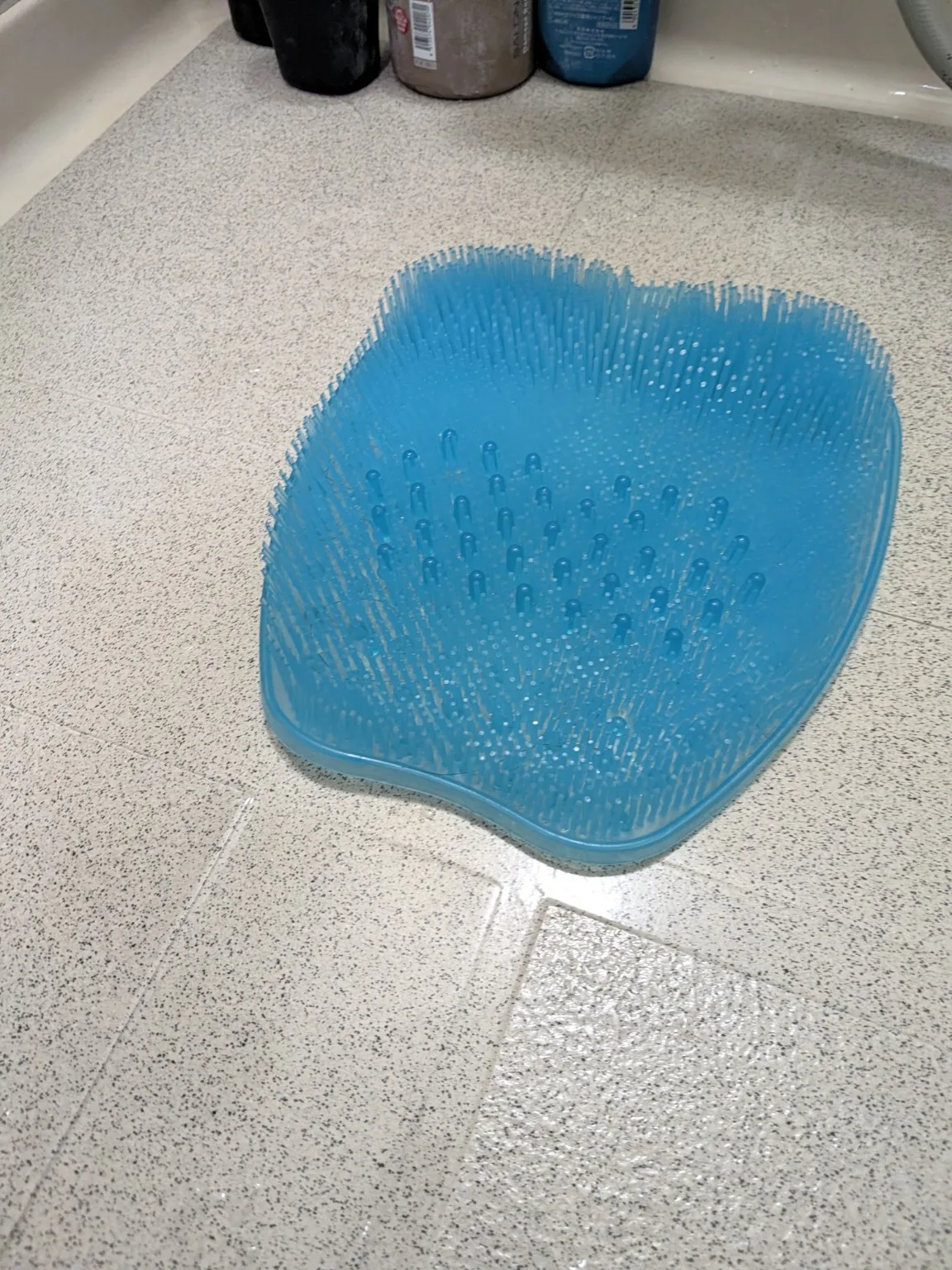
And it turned out to be a surprisingly good find.
I stand on the brush and move my feet over the bristles, washing the soles and the sides as well. The sensation was more intense than I expected.
Honestly, it hurt a little at first.
But after getting used to it, I started finding the sensation oddly satisfying.
It feels like I'm giving my feet a more thorough wash.
One important caveat: standing on a brush and pressing down in a wet bathroom can be slippery or rough on your skin. That's how I happened to use mine, not a technique I'm recommending. Use a stable position and gentle pressure, and stop if it hurts.
So what about the smell?
In my experience, since I started washing my feet with this brush, I haven't noticed that lingering odor after showering.
That's made a real difference to my routine.
I'm not claiming the brush has clinically proven deodorizing powers, and I haven't compared it with every other method. But the faint odor I used to notice after showering no longer bothers me, and that's made a genuine difference to my routine.
At this point, I can't live without it.
Well, I probably can.
But I'd rather not. (Laughs.)
Two small things I appreciate: the suction cups and the way it dries
The bristles aren't the only reason I've kept using this brush.
Turn it over and you'll find a whole bunch of suction cups on the underside.
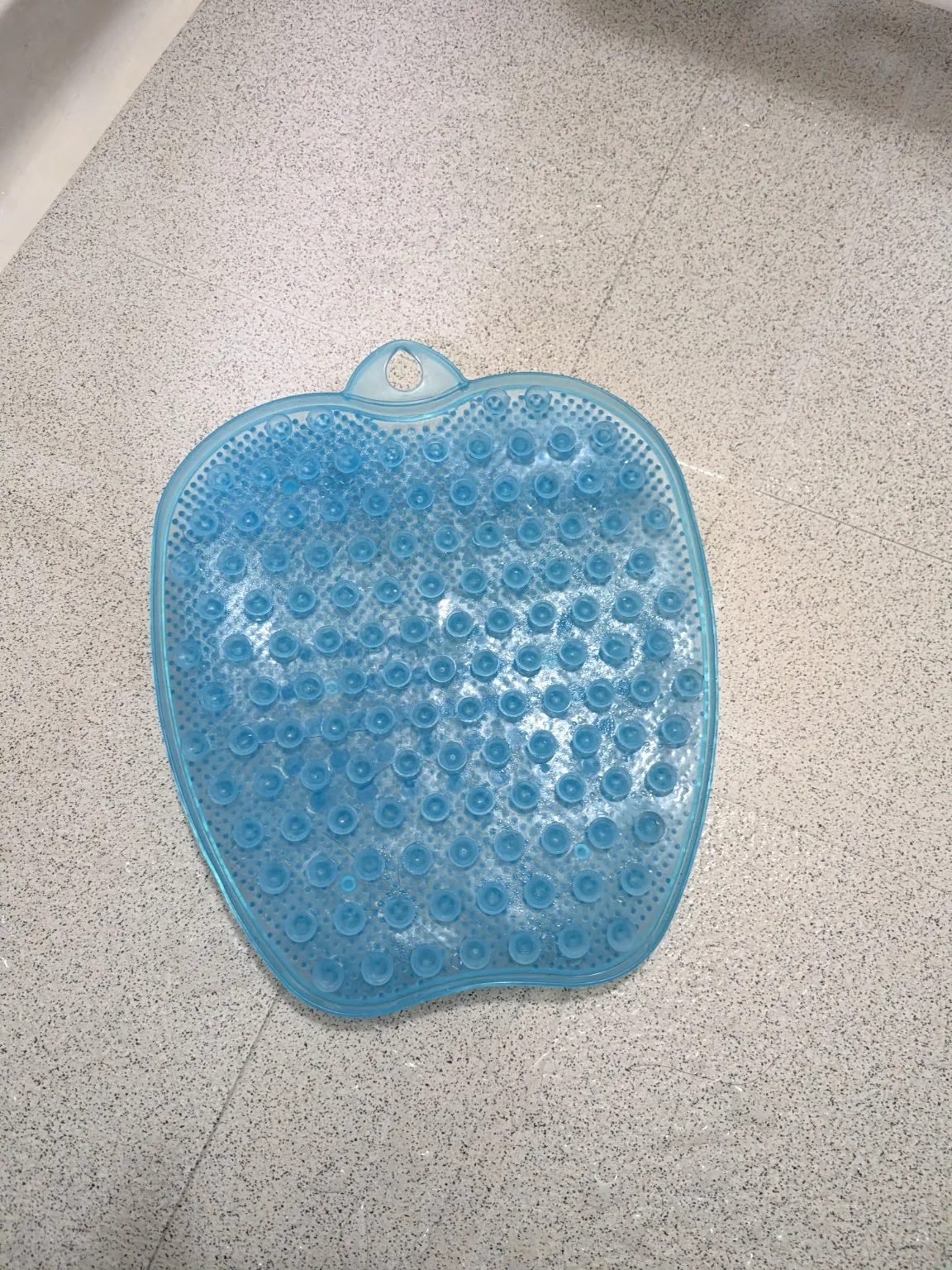
On my bathroom floor, they help hold the mat in place when I move my feet across it. I really appreciate that it doesn't shift around easily.
That doesn't mean it's slip-proof. Suction depends on the floor surface and whether the cups are properly attached. I'd always check that first and avoid putting too much weight on it.
There's another detail I like after showering: a small hole at the top lets me hang the brush from an S-hook.
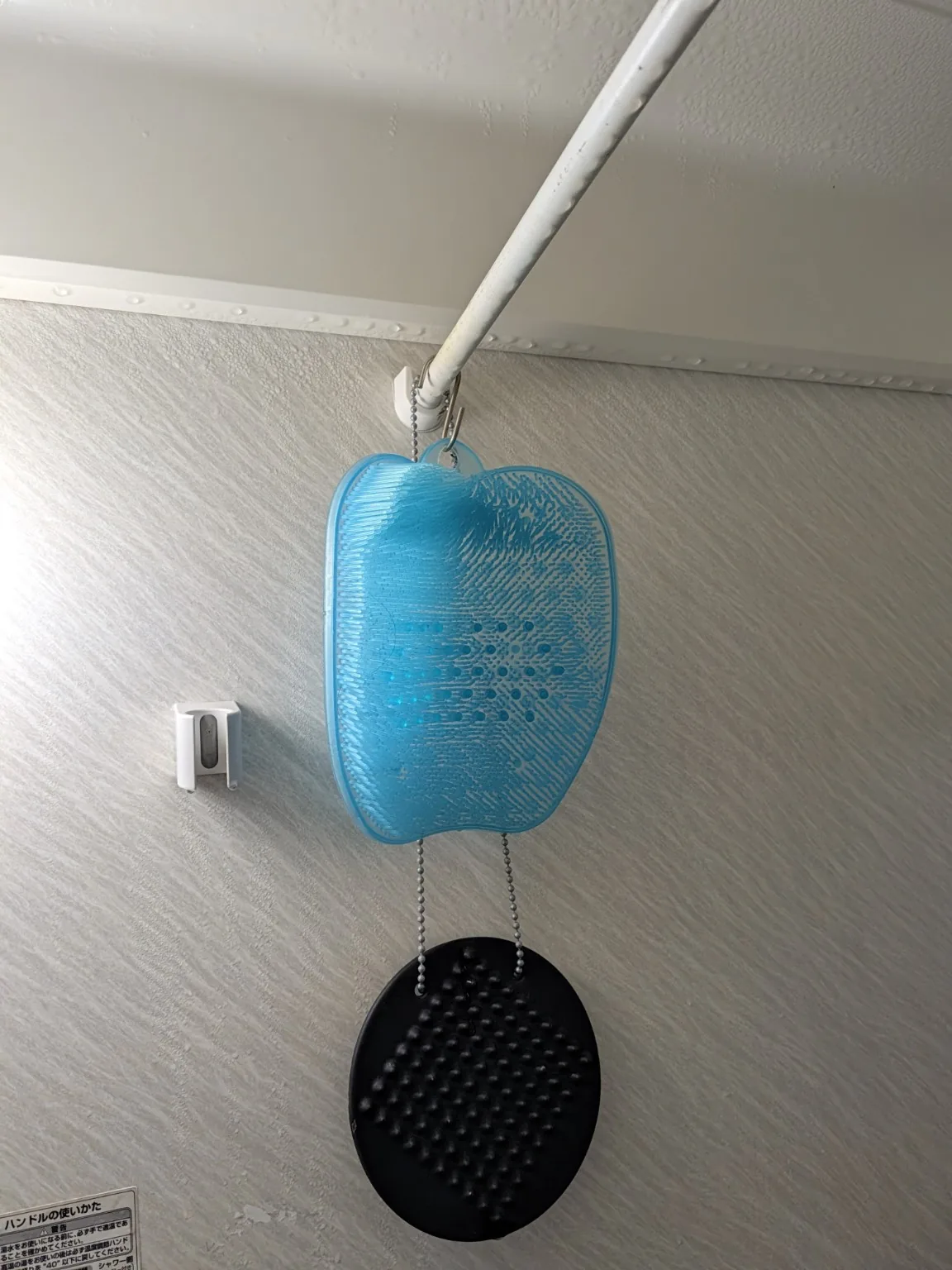
I rinse it and hang it up instead of leaving it lying wet on the floor. That makes it easier to drain and dry, which is a sensible part of keeping a bathroom item clean.
Of course, hanging it up doesn't magically make it mold-proof. It still needs cleaning and decent ventilation. But a grippy underside and a simple way to hang it dry are two practical details that make this particular brush easier for me to live with.
It's the foot brush I want to recommend, not one particular store
My brush happens to be from DAISO. But the useful discovery wasn't really the store — it was the idea of using a dedicated brush to wash my feet.
I'm still using body wash, just as before. What changed is the tool I use to clean my feet. I never expected something so simple to make such a difference to how my evening shower feels.
You can find shower foot scrubbers and foot-washing mats from various brands, including on Amazon. You don't need to find the same blue brush I happen to own.
They don't all have the same bristles, size or grip, though. I've only used my own brush, so I can't honestly say that every product will feel or perform the same.
If you're shopping for one, I'd look at how soft the bristles are, whether it can stay securely in place on your bathroom floor, and how easily it can be rinsed and dried between uses.
And of course, a brush isn't the whole answer to foot odor. Washing your feet and drying them carefully, including between your toes, still matter.
In the US, a comparable option is the BESKAR shower foot scrubber mat on Amazon.com (affiliate link). This is not the DAISO brush I personally use, and I haven't tested this particular Amazon product. It's here as a shopping reference for the same kind of tool, not as a first-hand review.
A surprisingly useful addition to the shower
When I think about deodorant, I tend to think about what to put on my skin: sprays, sticks, creams and the like.
Wolfthorn has become my underarm favorite. Alum stones are an interesting alternative. But for my feet, the more surprising change was how I washed them.
The brush ended up becoming part of my evening routine.
If you're visiting Japan, you might spot a similar brush at DAISO while browsing for everyday household things. It's a fun little find, but you certainly don't need to shop there to try the idea. Foot brushes are sold elsewhere, too.
For visitors who actually plan to shop in Japan, DAISO has an official store finder (in Japanese). I wouldn't send overseas readers to a Japan-only checkout page for this brush; the Amazon listing above is the more useful buying option for US readers. And there's no guarantee that every DAISO branch stocks the same brush.
And maybe buy one for yourself before giving one as a souvenir.
\"Here's something I got you in Japan!\"
\"...Are you saying my feet smell?\"
That could get awkward rather quickly. (Laughs.)
I even look forward to my shower when I get home now.
Wolfthorn variants and scent: Old Spice deodorant and Old Spice antiperspirant. Sources for alum deodorant: CRYSTAL mineral deodorant (manufacturer) and Al-Talib et al. (2016, in-vitro study). For basic foot-hygiene guidance, see NHS — Smelly feet.